
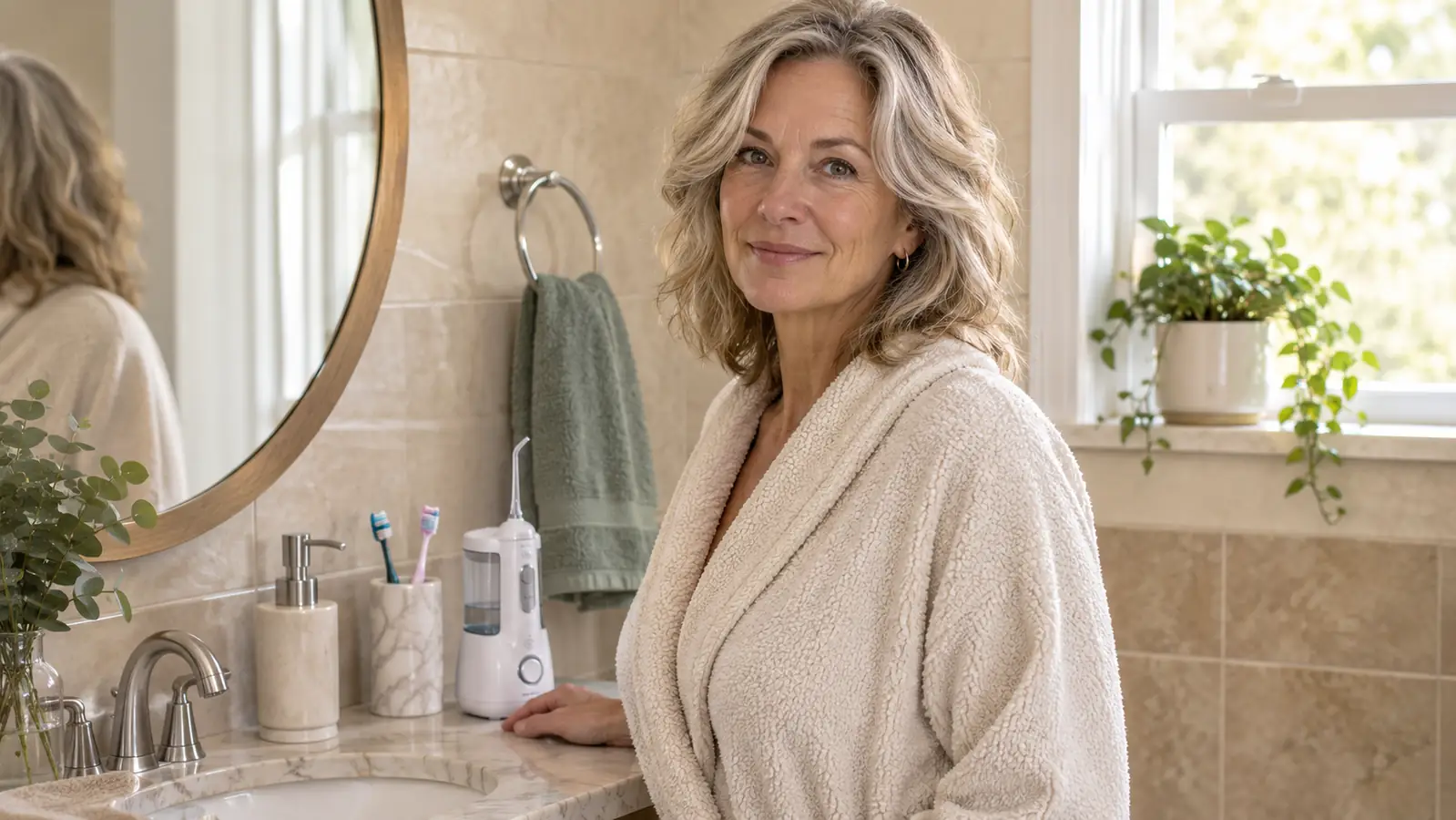
Gums are the part of your mouth you stop noticing until they complain. Mine started two years ago with a pink streak on the floss and a dull ache on the lower right whenever I drank something cold. My dentist said the sentence I used to say to other people when I worked the front desk of a dental practice: floss more, and floss better. Knowing what plaque does under the gum line and actually doing something about it every night are two different skills. I had the first one. I did not have the second. So I bought a Waterpik Aquarius, set it on the counter by the sink, and gave it a fair trial in a house with two bathrooms, hard water, and three people who all want the mirror at the same time.
What follows is the routine I landed on after a few weeks of spraying the mirror, spraying my shirt, and generally learning the machine. It is five steps, it takes about three minutes, and none of it is complicated. If you already own the Aquarius and it is sitting in a cabinet because the first attempt was a wet mess, this is for you. If you are still deciding, these same steps show you what daily use looks like in a real bathroom rather than a staged one.
Ninety seconds of water, once a night, is the whole ask
The Aquarius holds 22 ounces, runs 90 seconds or more per fill, and gives you 10 pressure settings plus a massage mode to work up through. See today's price on Amazon.
Amazon Check Today's Price on Amazon →The Five Steps, In Order
Step 1: Put It Where You Will Actually Use It
The machine is corded, so the sink with a working outlet nearby wins, and in our house that is the hall bathroom with the small vanity. The Aquarius measures roughly 3.8 by 4.7 by 10.3 inches and weighs about a pound and a half, so it takes up the footprint of a large coffee mug and stands about as tall as a loaf pan on end. It is not a drawer appliance. Plan for it to live out on the counter.
Two practical notes from a counter that is smaller than it looks. Keep the unit back from the edge of the basin, because the wand only reaches so far and you will be leaning forward over the sink. And leave yourself somewhere to set the wand down that is not a puddle. Ours sits on the left corner, opposite the toothbrush cup, so nobody knocks it sideways reaching for toothpaste at six in the morning.
Check the outlet before you commit to a spot. The hall bathroom has one, a GFCI on the wrong side of the mirror as far as I am concerned, and the cord reaches it only with the unit pushed into that left corner. If your outlet is behind the faucet or on the far wall, sort that out first, because a flosser you have to unplug and re-plug every night is a flosser that stays in the cabinet. I also wiped the counter dry before setting the unit down on day one and have kept that up, mostly because our hard water leaves a chalky ring under anything that sits in a puddle overnight.
The first placement I tried was on the prettier primary bathroom counter, next to a tray of things nobody uses. It lasted four days. The bathroom I walk past at ten at night is where the habit survived, and that is the only criterion that matters. Put it where your last bathroom trip of the day happens, not where it looks best in a photograph.
Step 2: Fill It and Start Lower Than You Think
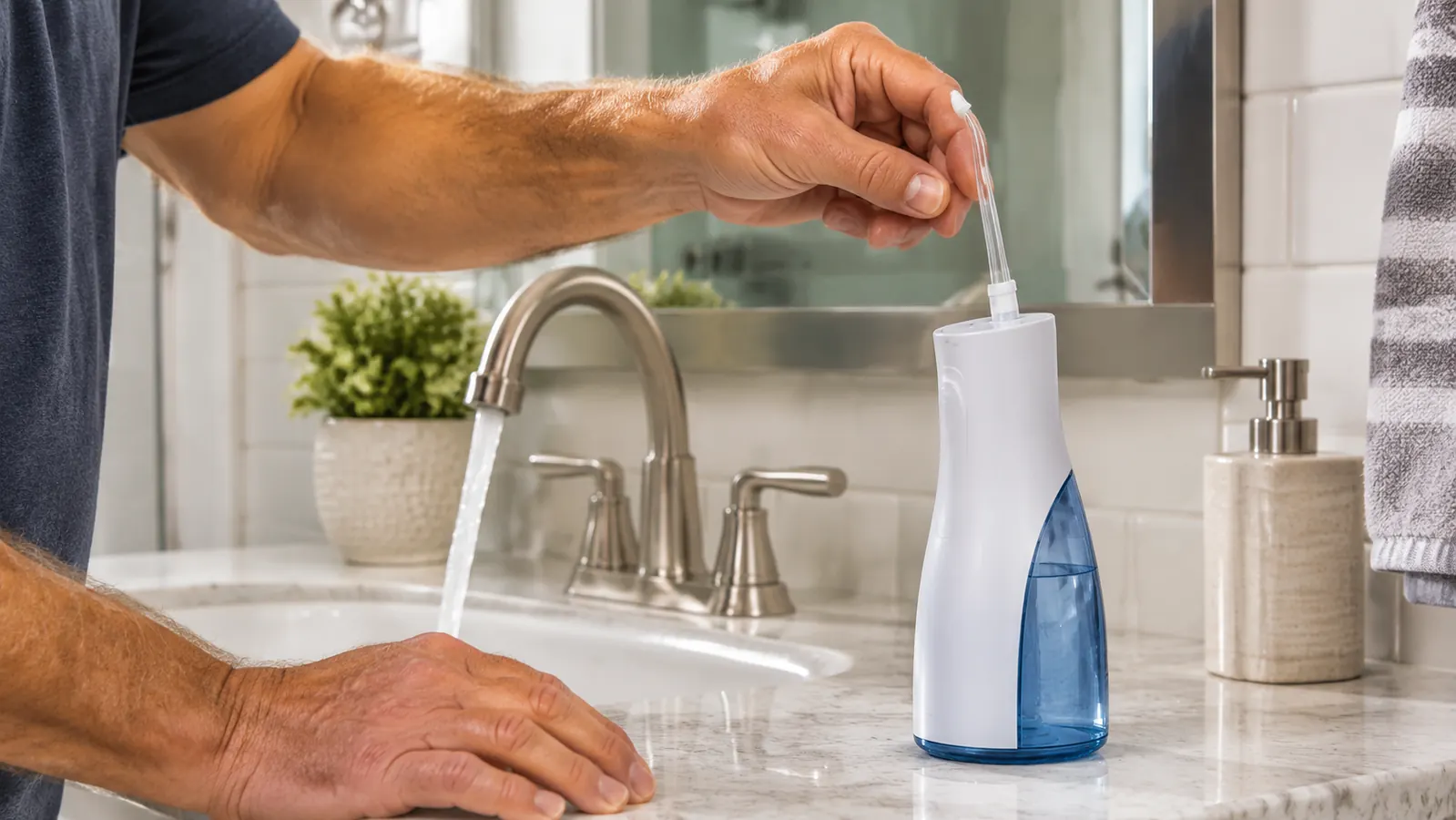
The reservoir holds 22 ounces, which the listing says gives you 90 seconds or more without a refill. In practice that is one full pass around both arches with a little left over, which is exactly what you want. I fill it with warm tap water. Our water is hard enough to leave spots on the glass, so I empty whatever remains and rinse the reservoir every night rather than letting it sit until morning.
The pressure control gives you 10 settings, plus a massage mode. Nearly everyone I have watched try one of these for the first time starts at 8, because 8 sounds reasonable. Start at 1 or 2 instead. I stayed at 2 for about two weeks, moved to 4, and now run at 5 on the outside surfaces and 3 behind the front teeth, where my gums are thinner and more opinionated. There is no prize for the highest setting.
One more thing about filling: use warm water, not cold. Cold water on a sensitive tooth is a sharp, bright feeling that makes you flinch, and flinching is how the mirror gets wet. Warm water also seems to loosen the soft film along the gum line a little faster. In summer I fill the reservoir before my own shower so the machine is ready when I get out. In winter I fill it after, because standing at a cold counter in a towel is its own deterrent. Small logistics, but the nights I skipped were almost always logistical, not lazy.
If your gums feel sore the next morning, that is information, not failure. Turn it down and stay down for another week. The pressure is adjustable for a reason, and the point of a daily habit is that you are still doing it in March. A setting that makes you dread the bathroom is the wrong setting, whatever the dial says.
Step 3: Learn to Aim Before You Turn Up the Pressure
Lean over the sink before you press anything. Close your lips most of the way and let the water fall out of your mouth into the basin instead of spraying across the mirror. It feels strange for about three nights. Then it stops feeling like anything at all, which is how you know it turned into a habit.
Aim at the gum line, where the tooth meets the tissue, at roughly a right angle. Not straight down the chewing surface, and not at one spot until it stings. Short pulses, move along a few teeth, pause, move again. For the first week I used a hand mirror to check my angle, which sounds fussy and saved me a month of doing it wrong.
Marcus tried it once at 9 and came out of the bathroom with wet shoulders and a strong opinion about the whole enterprise. He runs it at 3 now and keeps his lips closed the entire time, which is the whole trick. I keep a folded hand towel on the counter within reach, not for drying hands but for the two seconds after you switch the unit off, when the wand still has a drop in it. That drop lands on the counter nine times out of ten, and wiping it right away is the difference between a counter that looks cared for and one with a mineral ring by Thursday.
Two shirts and one bath mat paid for this lesson. Switch the unit on after the wand is in your mouth, not before. Nearly every account I have heard of someone abandoning a Waterpik starts with a jet of water hitting a shirt at close range on night one.
Ten settings, a 22-ounce reservoir, roughly ninety seconds of water. The machine was never the hard part. Leaving it on the counter where I would see it at ten at night was.
Step 4: Work in a Fixed Order So You Stop Skipping the Back
Order matters more than technique, because the back molars are where I used to quit. I start at the furthest back tooth on the upper right, outside, and work forward toward the middle. Then the upper left, the same way. Then the lower right and the lower left. Then the inside of both arches, which takes about twenty seconds and is the section everyone skips.
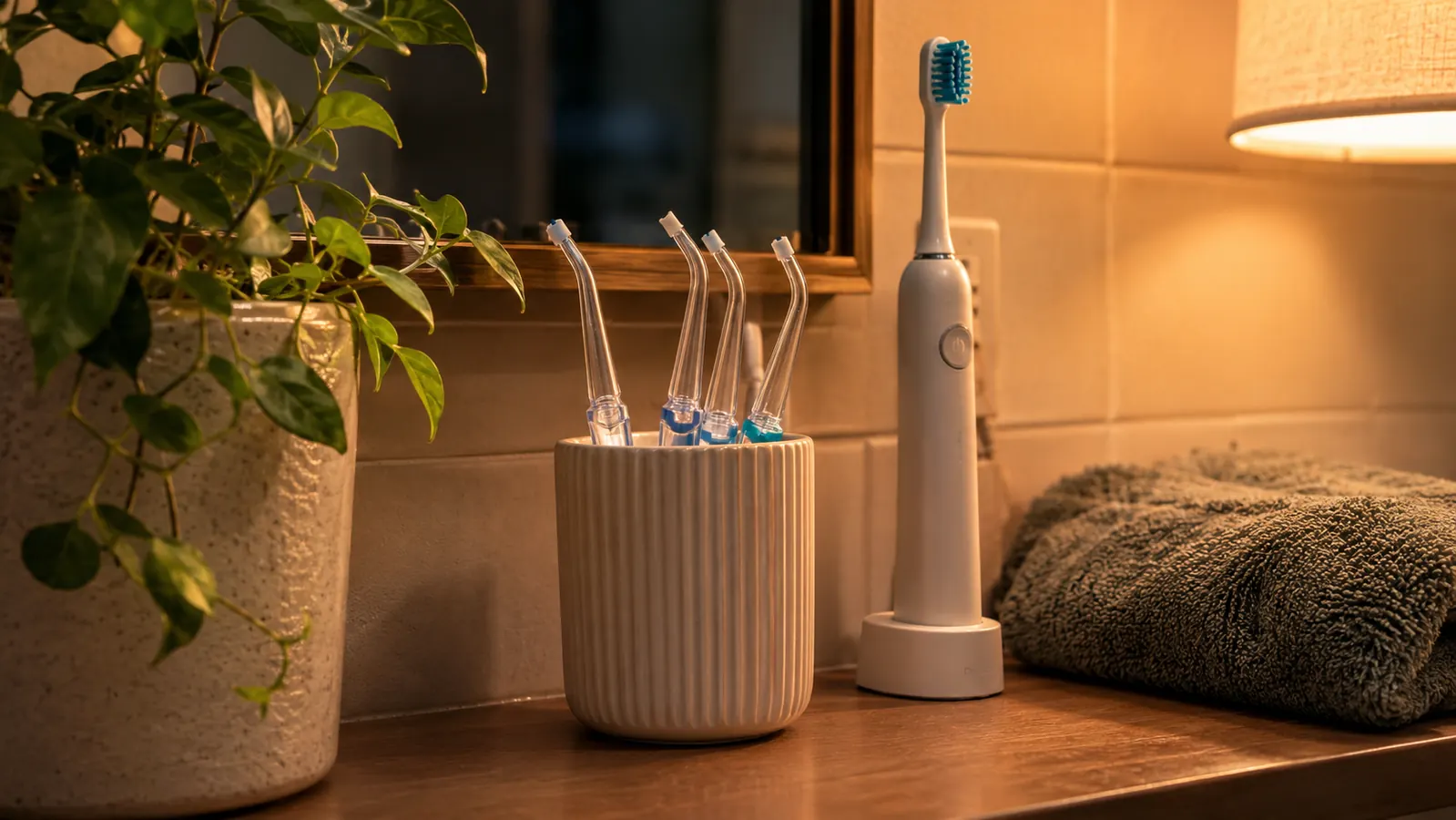
The Waterpik box includes seven tips: four precision tips, one Plaque Seeker tip, one Pik Pocket tip and one orthodontic tip. I use a precision tip on most nights. The Pik Pocket tip is the one for a softer stream into the pocket areas my dentist pointed out, and I use it twice a week on the lower right. The orthodontic tip is there for anyone in the house with braces. Each of us has our own tip, kept in a cup on the shelf, and nobody borrows.
For the first month I used the Plaque Seeker tip almost every night, because the wider fan felt like it was doing more work. It covers ground faster, but it also made me lazy about moving the wand, so the far corners got one broad pass instead of a real one. Now the Plaque Seeker comes out on calm nights when I want speed, and the precision tip does the ordinary work. The Pik Pocket stays at twice a week, lower right only, exactly where my dentist aimed a finger.
Ninety seconds of water sounds generous until you spend half of it on the two teeth you already brush well. Move steadily. About a minute per arch is the pace I settled on, and I count the passes under my breath on tired nights, because tired is exactly when the back corners get skipped.
Step 5: Clean the Unit and Anchor the Habit
The nightly close-out takes about thirty seconds. Empty the reservoir, rinse it, wipe the base and the wand with a hand towel, and set the wand down on the folded towel beside it. Once a week I run a reservoir of warm water with a splash of white vinegar through the unit, then a clean reservoir of plain water. Our hard water makes that necessary. Follow the Waterpik manual on cleaning, which is short and specific and covers the parts I would otherwise have guessed at.
The habit itself needed an anchor. Mine is the last toothbrushing of the night, before I change out of my clothes, not after. When I moved it to after pajamas it slid to eleven o'clock and then to never. Three minutes at the counter is a smaller thing to give up than the appointments I used to schedule for other people.
Watch for pink in the sink and tenderness in the first couple of weeks, and treat both as a reason to go softer rather than harder. If bleeding continues past a few weeks, or if one specific spot hurts when nothing is touching it, that is a conversation for your dentist, not a setting adjustment. I say that as someone who spent nine years booking those conversations.
What Else Helps
A Waterpik sits on top of the basics. It does not replace them. Two minutes with a soft brush and fluoride toothpaste, twice a day, still does most of the work. String floss still earns its place between teeth that touch closely, where a stream of water cannot reach the contact point. I floss with string three nights a week and use the Aquarius every night, which is a compromise that has held for two years.
The order I use is brush, then flosser, then a fluoride rinse. Running the flosser first means pushing debris around a mouth still full of toothpaste foam, and the whole thing feels busier than it needs to. Ray does it the other way around and his gums are fine, so this is preference, not law.
The rest is unglamorous. Keep the counter dry so the base is not sitting in water. Replace a tip when it starts to look worn, and never share one. Leave the flosser where you can see it, because a cabinet is where good intentions go to die. And keep your regular cleaning appointments, since the entire point of doing this daily is that the professional visit gets shorter and a lot less interesting.
The habit is worth more than the setting you pick
10 settings, 7 tips, a 22-ounce reservoir that runs 90 seconds or more, and a 3-year limited manufacturer's warranty. If you are going to do this every night, do it with a machine that earns its spot on the counter. Check today's price on Amazon.
Amazon Check Today's Price on Amazon →