

Short answer first. String floss still cleans the tight contact points between your teeth better than a spray of water does. The Waterpik Aquarius does two things floss cannot: it rinses below the gumline, and it cleans around brackets, bridges and crowns without threading anything. Most adults with gums worth worrying about end up needing both. But if only one of them is going to get used every single night, the one that actually gets used wins, and for a lot of people with tender gums that is the Aquarius.
I am not a neutral party here, and I will say so up front. I spent nine years running the front desk of a dental office before I started writing about household basics, so I have heard the floss argument from both sides of the chair, the hygienist side and the patient who is quietly sure they are being nagged. My own dentist told me plainly to take better care of my gums. My mouth has tight contacts and a couple of older fillings that catch everything. At home I keep a Waterpik Aquarius on the counter in the primary bathroom and a container of string floss in the drawer of the hall bath. That is the setup I would recommend to most families, and this is the reasoning behind it.
One note on how this was tested, because I want to be clear about what it is worth. I did not run a lab. I ran a bathroom in a 1990s two-story house outside Houston, with hard water, one shared hall bath and one primary bath, a husband who works shifts and a sixteen-year-old who would rather do almost anything else. I used the Aquarius through a full reservoir most nights for several months, and on the other nights I flossed the way a hygienist taught me, wrapping the floss into a C shape and sliding it against the side of each tooth. Everything below comes out of that, not out of a spec sheet.
| Waterpik Aquarius | String floss | |
|---|---|---|
| Tight contact points | A spray hits the contact between two teeth and much of it glances off | Floss goes in, wraps the tooth and physically wipes the surface |
| Below the gumline | The stream rinses under the gum margin, and the Pik Pocket Tip is shaped for that area | Reaches the side of the tooth and stops where the gum does |
| Braces, bridges, crowns | Seven tips in the box, including an orthodontic tip and a Plaque Seeker tip for around hardware | Threading under bridgework or around a bracket takes real patience and most people skip it |
| Tender or bleeding gums | You choose from 10 pressure settings, so you can start low and build up as the gums settle | Contact against sore gums is sharp and all or nothing |
| Technique required | Aim the small wand at the gumline and move along the teeth | Correct C shape, careful wrap, a couple of minutes of real dexterity |
| Time per use | More than 90 seconds of spray from the reservoir, plus filling and emptying | A careful job takes a couple of minutes, a rushed pass takes thirty seconds |
| Counter space | 3.8 by 4.7 by 10.3 inches and about 1.5 pounds, standing there permanently | Lives in a drawer |
| Mess | Water reaches the mirror and the front of your shirt until you learn to close your lips around the wand | No water, no cleanup |
| Travel | Corded electric, so it stays home | Goes in a toiletry bag |
| Ongoing cost | One purchase up front, plus replacement tips over time | Bought on repeat forever, and still the cheaper habit by a wide margin |
| Warranty | 3-year limited manufacturer's warranty | None, it is disposable |
Where Waterpik Wins
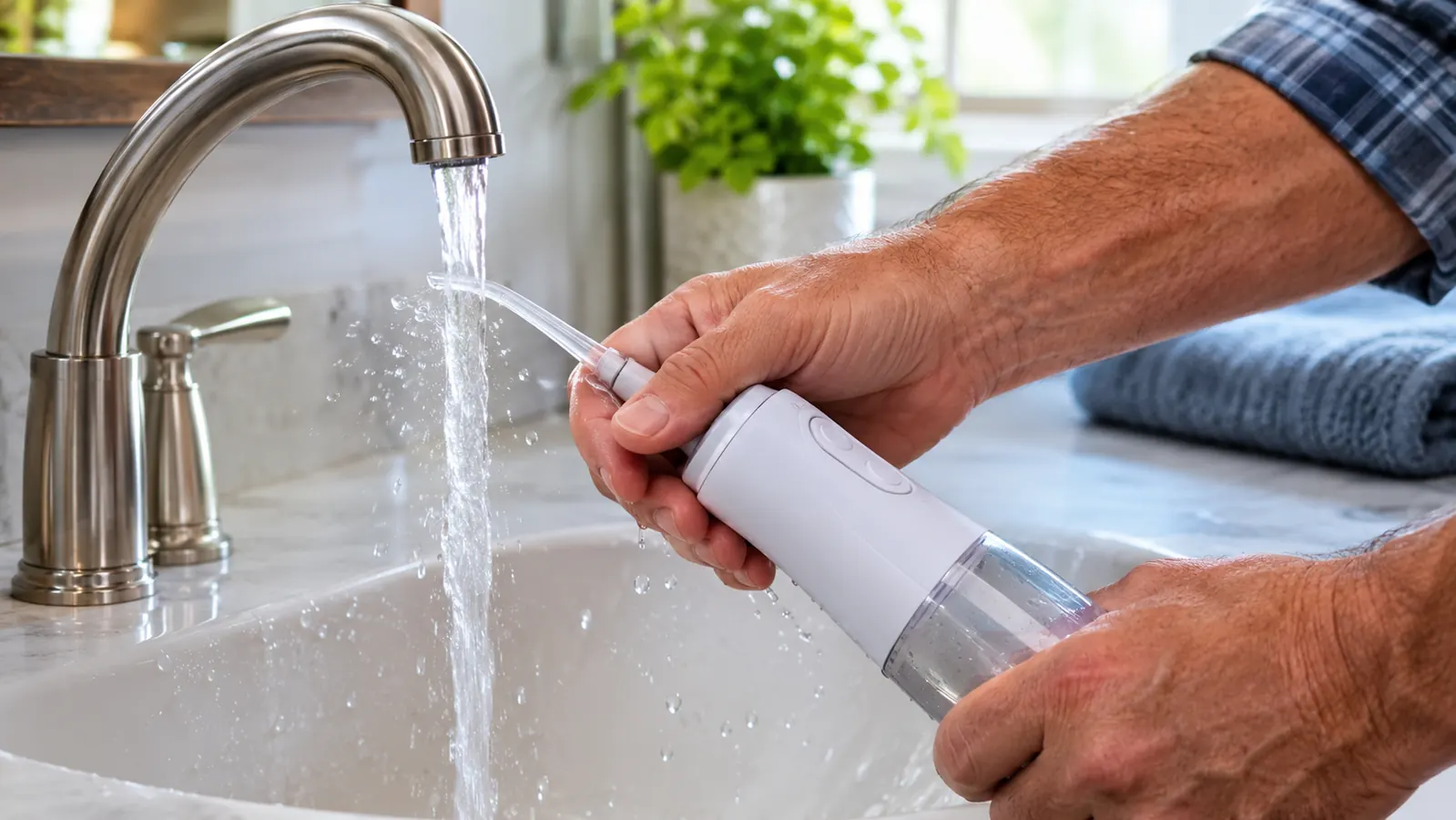
The gumline is where the Aquarius earns its counter space. Floss reaches the side of a tooth and stops where the gum begins. A pressurized stream does not stop there. The Pik Pocket Tip in the box is shaped for the area just under the gum margin, and after a few weeks of nightly use my hygienist stopped finding the same tender spot on the lower right that she had been pointing out for years. That spot is the lower right second molar, and it turned up in the same sentence at every six-month cleaning going back to 2021: a little bleeding here, nothing dramatic, keep an eye on it. I noticed the change myself around week three, mostly because the water stopped coming back pink in the basin. By my cleaning in the spring she said it looked quiet. Nothing in my routine changed except the machine on the counter. Start on the low end of the 10 pressure settings. There is no prize for beginning at the top, and starting high is how people decide a water flosser hurts and put it in a cabinet.
If you have braces, a permanent retainer, a bridge or a crown, this stops being a real contest. Threading floss under bridgework is a skill, and most people who claim to do it nightly are not doing it. The Aquarius ships with seven tips, including an orthodontic tip for brackets and a Plaque Seeker tip for the margins around crowns, along with four precision tips for everyday use. You aim, you spray, you move to the next gap. Nothing has to be threaded under anything, which means the cleanup around hardware actually happens instead of being intended.
The third advantage is duller and probably matters more than the first two. A thing you will actually do beats a technique you skip. I kept a tally through one February, because February is the month I quit things. Thirty-one nights, and I used the machine twenty-six of them. A tally I kept in an earlier year, floss alone, would have come in closer to twelve, and I know that because I have run that experiment on myself more than once and lost it every time. The reservoir holds 22 ounces, which is more than 90 seconds of spray, so there is no stopping halfway to refill. It is corded electric and it sits on the counter, which makes it a one-button decision at 11 pm when you are tired and the alternative is opening a drawer, pulling a length of floss and doing careful work. The Aquarius is ADA Accepted for safety and effectiveness, and the massage mode is a pleasant change on a night when your gums feel puffy. It also carries a three-year limited manufacturer's warranty, which tells you something about how the company expects it to hold up.
Where String Floss Wins
String floss wins the contact points, and I am not going to dress that up. Where two teeth touch, the gap is narrow. A spray hits that spot and a good portion of the water bounces away. Floss goes in, wraps the side of the tooth and wipes it. If your dentist keeps finding plaque between your molars at every visit, floss is the tool addressing the actual problem. This is also why the pair works better than either alone. Floss the contacts, then run a reservoir of water to rinse out what the floss loosened, and you have covered both jobs in about four minutes.
Then there is everything about owning the thing. Floss costs almost nothing, lives in a drawer, travels in a toiletry bag and never needs a socket. The Aquarius takes up a permanent corner of the counter, and at 3.8 by 4.7 by 10.3 inches it is not a small object sitting next to the soap. Our vanity is one piece of cultured marble with maybe three feet of usable space to the left of the sink, so 4.7 inches is a real slice of it. I moved the soap dish twice before I found a spot that did not feel crowded. Because it is corded, it stays home. And it splashes. My first week I kept a hand towel folded on the counter and still hit the mirror twice. Until you learn to close your lips around the wand, water finds the mirror, the faucet and the front of your shirt. Ray, who has a heavier hand than I do, got the front of his shirt on his first evening and came out of the bathroom saying the machine had won. I have never once had to wipe down a mirror after flossing.
Floss is also faster when you are in a hurry and honest enough to admit you are doing a fast pass rather than a thorough one. A careful job with floss takes a couple of minutes. A quick job takes thirty seconds and still does something useful. The Aquarius takes more than 90 seconds of spray plus filling and emptying the tank. That is not a huge difference on paper, but at 11 pm on a Tuesday it is the difference between doing it and deciding to do it tomorrow. The honest version of that is a thirty-second pass is not a real clean and I know it. But a thirty-second pass and a rinse still beats a good intention.
Floss wins the contact points. The Aquarius wins the gumline and the nights I would otherwise skip. The machine I use every night beats the technique I use twice a week.
The part floss cannot reach is the part that keeps bleeding
Ten pressure settings, seven tips including one made for the gum margin, and a 22-ounce reservoir that runs more than 90 seconds without a refill. Check today's price on Amazon and see what the current listing includes.
Amazon Check Today's Price on Amazon →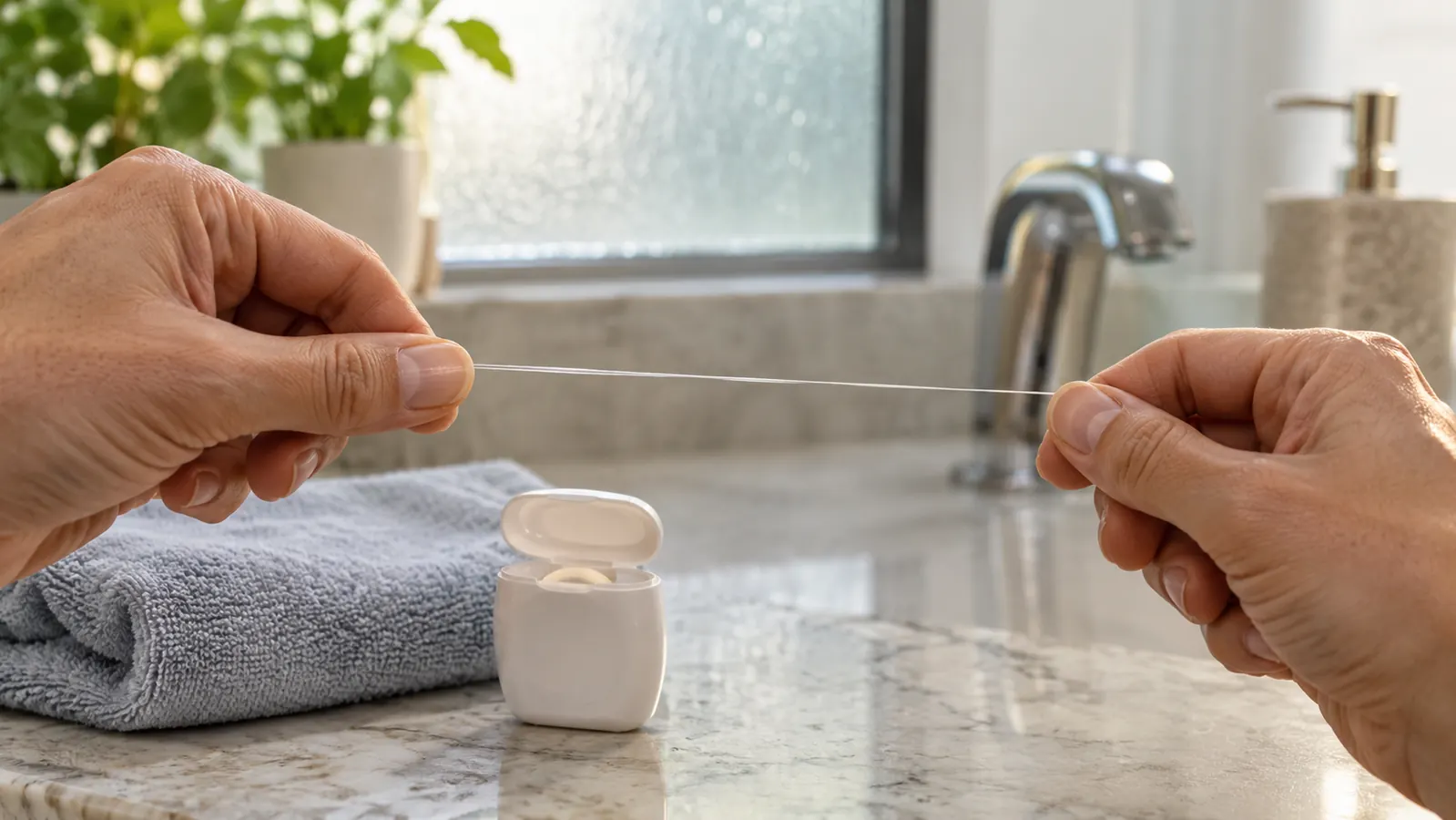
The Part Nobody Mentions
Expect a little blood the first week, and do not take it as a sign you are doing damage. Gums that have not been rinsed under the margin in years respond to the new attention the way a muscle responds to a first workout. I started on a low setting, stayed there for a week, and moved up one notch at a time. If your gums bleed nightly past the second week, that is a question for your dentist, not for a review on the internet. The same goes for anything that feels like pain rather than pressure.
Upkeep is the unglamorous half of owning a countertop flosser. We have hard water here, and a reservoir left full will get a film on the inside of the tank. Houston water is not kind to anything it sits in. The first month I left the tank full overnight more than once, out of laziness rather than ignorance, and by the fourth week there was a chalky ring around the inside about an inch off the bottom. It came off after a soak, but I stopped giving it the chance. Now it is a thirty-second job after each use: dump it, shake it out, leave the lid open to dry, wipe the outside of the unit. Once a week, usually Sunday while the kettle is getting the same treatment, I run a mix of water and a little white vinegar through it. Replacement tips are not forever either. They wear and stop spraying evenly, so keep a spare set in the drawer with the floss you are still going to use.
And keep the floss. That is the part I would push back on if a friend told me they had replaced flossing entirely with a water flosser. My own routine is the flosser on most nights and string floss two or three times a week, focused on the back molars where my contacts are tightest. The hall bathroom has floss in the drawer and no machine at all, because that bathroom is used by a teenager in a hurry and a machine does not belong there. Two bathrooms, two setups, one habit.
Who Should Buy Which
Buy the Waterpik Aquarius if your dentist has been talking to you about your gums, if your gums bleed when you floss, if you have braces, a permanent retainer, a bridge or several crowns, or if you have already proved to yourself that you will not floss consistently. Buy it if you want one device on the counter that handles the gumline, the hardware and the rinse in a single pass without any threading. What you are paying for is not a gadget. It is the fact that the job gets done on a Tuesday night in February when you are tired.
Stick with string floss alone if your teeth are spaced enough that floss slides easily, if your gums are healthy and your hygienist has nothing to say at cleanings, if you travel often, or if counter space in your bathroom is already contested. Floss is the better tool for tight contacts and it always will be, and if your dentist is happy at every cleaning, you do not need to buy a machine to solve a problem you do not have. In our house the hall bath stays a floss-only zone, because it gets used by a sixteen-year-old on a school morning and a machine that has to be filled and emptied would not survive that schedule. Marcus is in and out of there in under four minutes flat and I have watched him do it. If you are undecided, the honest middle is to buy the Aquarius, keep the floss you already own, and give it a month. After thirty nights you will know which one you reach for, and that answer is worth more than any comparison table, including this one.
Start with the gumline. Keep the floss in the drawer.
The Aquarius is the tool that gets used on the tired nights. Ten settings, seven tips, a 22-ounce reservoir and a three-year limited warranty. Check today's price on Amazon before you decide.
Amazon Check Today's Price on Amazon →