
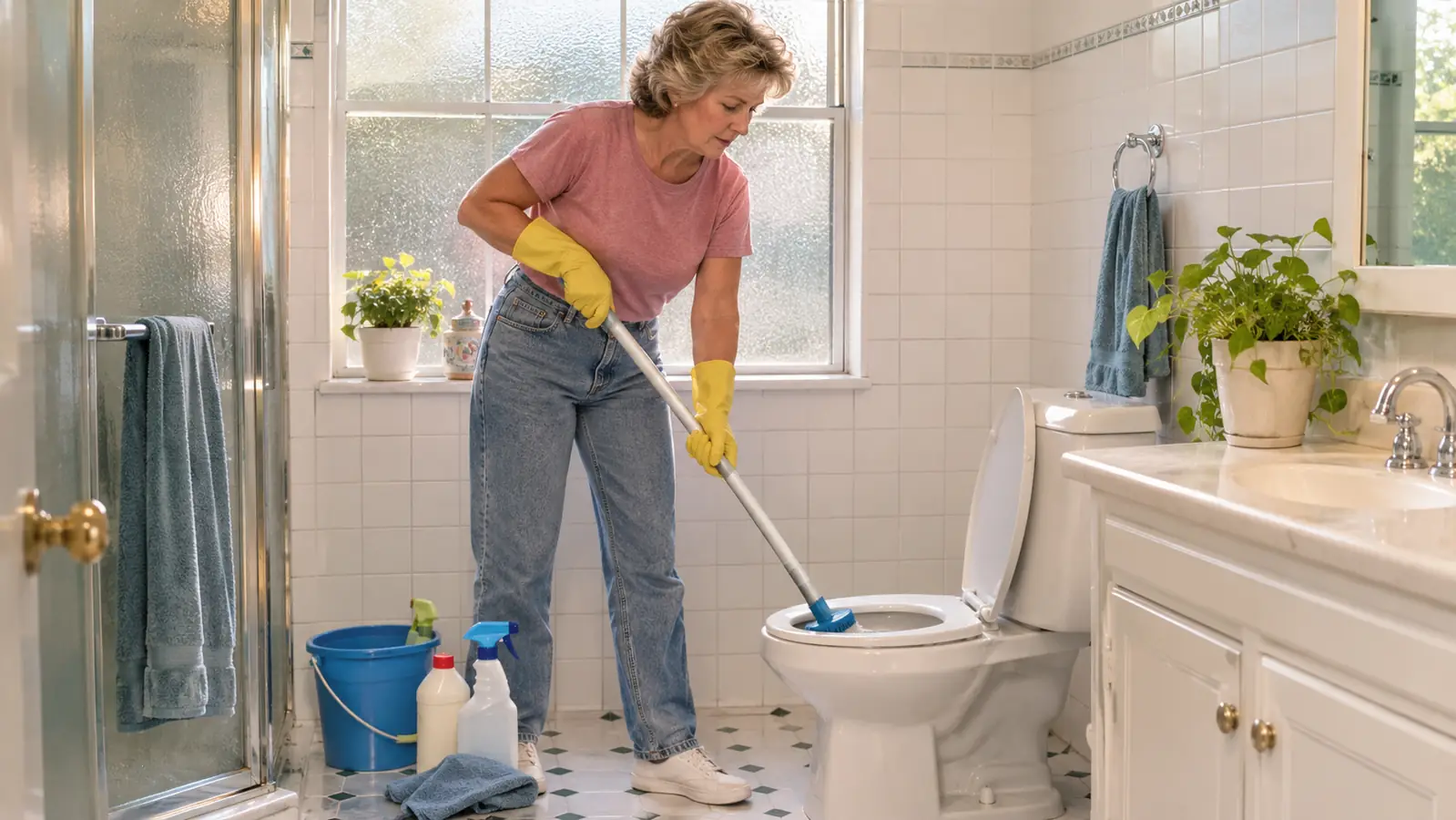
A toilet brush does not get dirty because you are careless. It gets dirty because the tool is built to hold onto the thing you are trying to remove. That is the short version of why I moved the primary bathroom to the Clorox ToiletWand and left a plain brush in the hall bath for a few weeks. I am 52, I live outside Houston with hard water, and I have cleaned two bathrooms for a house of three long enough to know that a tool you dread touching does not get used as often as it should. This is not a review of which brand is nicer. It is a comparison of two tools that do the same job in different ways.
Here is the short answer. The Clorox ToiletWand is the cleaner tool for the person who wants a fresh scrubbing surface and no brush bristles sitting in a holder. A toilet brush is the better tool for the person who wants one purchase, no refills, and no disposable pad going in the trash after every clean. Neither one is the right answer for every bathroom. I use both in my house, in two bathrooms that get different levels of traffic, and the rest of this is how I got there. That includes the parts where the brush still wins.
| Clorox ToiletWand | Traditional toilet brush | |
|---|---|---|
| What touches the bowl | A fresh disposable scrubbing pad with cleaner already on it | The same bristle head, rinsed and stored between uses |
| Germ kill claim | The pad and cleaner are labeled to kill 99.9% of germs | No disinfecting claim on its own; depends on the cleaner you add |
| Hard water and lime | Labeled to eliminate hard water and lime stains 2X faster than a brush with manual cleaner | Results depend on the cleaner you use and the pressure you apply |
| Reach | Long handle helps you clean from a distance | Handle length varies; many brushes put you closer to the bowl |
| Refills | You replace the pad after each clean and reorder refill heads | One tool with no refill heads to buy |
| Waste | A disposable pad goes in the trash after every clean | No per-use trash from the cleaning head |
| Cleaner choice | The pad is preloaded, so the cleaner is fixed | You choose the cleaner and the amount |
| Storage | The wand and refill heads need shelf or cabinet space | A brush and holder sit beside the toilet |
| Best for | A bathroom cleaned often that needs less contact and a fresh pad | A bathroom cleaned less often where one simple tool is enough |
What the Clorox ToiletWand Actually Is
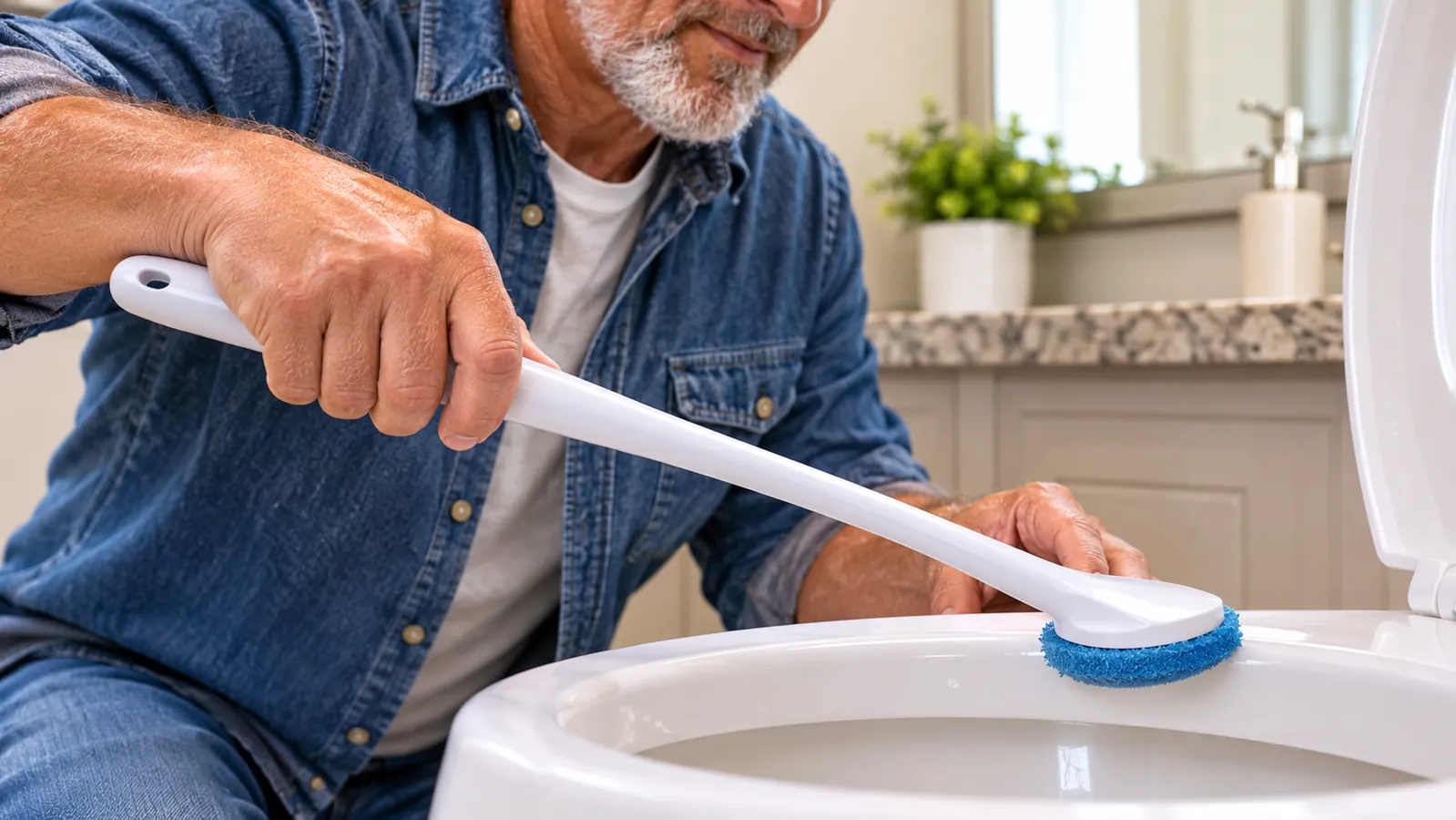
The Clorox ToiletWand kit is a wand with a long handle and 16 refill heads. The listing says the pads are preloaded with cleaner and that the cleaner kills 99.9% of germs. It also says the cleaning solution eliminates hard water and lime stains 2X faster than using a toilet brush with manual toilet bowl cleaner. The formula is listed as bleach free, and the scent is listed as Rain. The product dimensions are 4.75 by 4.41 by 16.81 inches, and the kit weighs 14.82 ounces. I care about the long handle because it lets me clean from a distance. I care about the preloaded pad because it removes a step. I do not have to find a bottle of cleaner, pour it, and then put the bottle away while the brush drips.
The point of the tool is that it replaces your liquid cleaner and your brush. That is not marketing language in my house. It is the difference between one object I pick up and two objects I have to coordinate. The pad is the scrubbing surface and the cleaner is already on it. When I am done, the pad goes in the trash and the wand goes back on the shelf. The brush has to be rinsed, shaken out, and put back in a holder that is usually wet. I have done both. The Clorox version is easier to pick up, and easier is what gets a bathroom cleaned on a Tuesday when nobody is coming over.
How I Tested Both in a Two-Bathroom House
I did not run a lab test. I ran a household test. My husband Ray and I use the primary bathroom, and our son Marcus uses the hall bath. Both toilets are porcelain, both get hard water, and both get cleaned once a week whether they look like they need it or not. For three weeks I used the Clorox ToiletWand in the primary bath and a standard toilet brush with my usual bathroom cleaner in the hall bath. I spot-cleaned the primary ring midweek when I saw it starting. I did the same in the hall bath. I did not change my cleaning schedule to make one tool look better.
The first thing I noticed was not a stain. It was the storage. The brush sits in a holder beside the toilet and stays damp. The Clorox wand does not sit in the bowl water and does not have a bristle head holding onto whatever it just scrubbed. The refill heads stay in the cabinet until I need one. That alone made the primary bath feel less like a chore. The hall bath brush was not a disaster. It was just a wet brush in a holder, which is what a brush is. The difference is that I did not have to look at the Clorox pad after I used it. It was already in the trash.
The second thing I noticed was the hard water ring. Our water leaves a chalky line around the waterline if I skip a week. With the brush, I sprayed the bowl, scrubbed the ring, and often went back over it a second time. With the Clorox ToiletWand, I used the preloaded pad, scrubbed the ring, and let the cleaner sit for about a minute before I flushed. It took less back-and-forth. I did not time it with a stopwatch, so I will not tell you it was exactly twice as fast. I will tell you the ring came off with less scrubbing, and the pad had cleaner on it from the start instead of me adding cleaner to a brush.
What 16 Refill Heads Means in a Real House
The kit comes with 16 refill heads. In my house, that is four months of weekly cleaning in one bathroom, plus a few extra for the weeks when the toilet needs a midweek pass. That math is worth doing before you decide the refills are a hassle. If you clean two bathrooms every week, the same 16 pads last about two months. If you clean one bathroom and you only use the wand for the bowl, you will not be ordering refills every other week. I keep the spare heads in the cabinet under the sink, and I check the supply when I check the rest of the bathroom. That is the same habit I already have for toothpaste and toilet paper.
The refill count is also where the Clorox ToiletWand asks something of you. You have to keep the heads on hand. If you run out, you are back to the brush or you are cleaning with a bare wand, which is not the point. I solved that by ordering a second box before the first one ran out, the same way I handle dishwasher tablets. That is a small bit of planning. The brush never asks for planning. It is always ready, even if it is wet and unpleasant. This is the honest trade. The Clorox tool gives you a cleaner surface per use, and the trade is a supply you have to manage.
Where Clorox ToiletWand Wins
The first win is the one I notice every Saturday morning: the pad is new. The Clorox ToiletWand kit comes with 16 refill heads, and each one is preloaded with cleaner. I am not putting a bristle head that has been sitting in a holder back into the bowl. I am not rinsing a brush and watching the water run off it. I use a pad, I clean the bowl, I remove the pad, and it goes in the trash. That sounds small until you have cleaned a hall bath used by a 16-year-old boy. The real difference is not about being squeamish. It is about how often the job actually gets done. When the tool is pleasant enough to pick up, the toilet gets cleaned more often, and a toilet cleaned more often is a cleaner toilet.
The second win is the cleaner itself. The listing says the pad and cleaner kill 99.9% of germs and eliminate hard water and lime stains 2X faster than a toilet brush with manual toilet bowl cleaner. I have hard water, so that claim is the one I tested with my eyes. The Clorox pad put a disinfecting cleaner directly on the stain. The brush relied on me to spray first and scrub after. The long handle also meant I was not leaning into the bowl to reach the back. That matters for my back and for my patience. I still scrubbed. I still had to pay attention to the waterline. The tool did not do the work for me. It just removed the friction that makes me put the work off.
The pad is preloaded with cleaner and labeled to kill 99.9% of germs, so the disinfecting step is not a separate bottle I have to find under the sink.
Where a Toilet Brush Wins
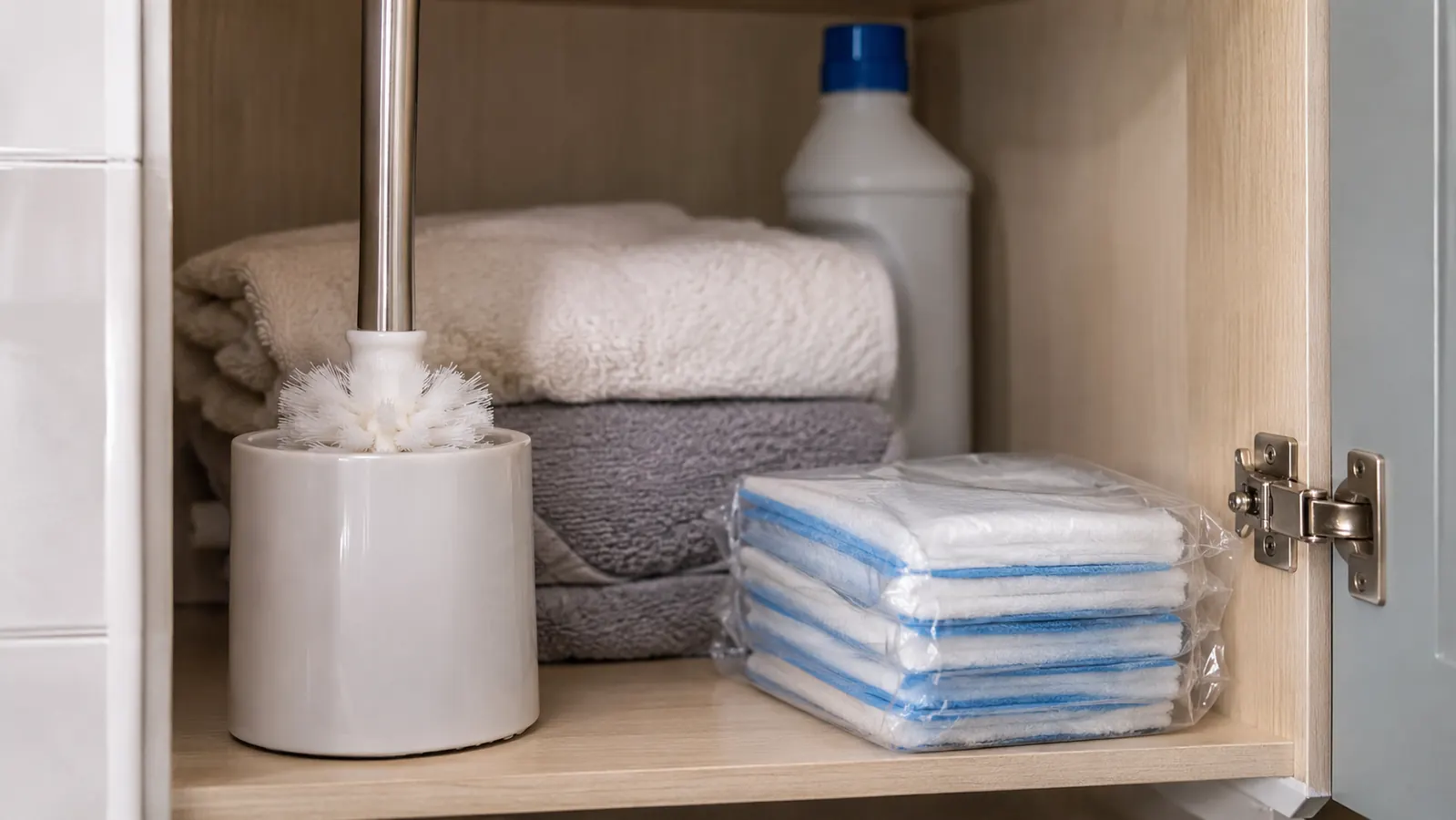
The brush wins on repeat buying and waste. A toilet brush does not need refill heads. You buy one, you use it, you rinse it, and you replace it when the bristles wear out. There is no pad to add to the trash after every cleaning and no refill to forget to order. In a house where I already keep a running list on the fridge, that simplicity has value. The Clorox ToiletWand is a system. The brush is a tool. If you do not want to think about supplies, the brush asks less of you. It also does not depend on a refill being in stock when you need it.
The brush also wins on control. You choose the cleaner, you choose how much you use, and you can scrub as hard as the brush and the bowl allow. A disposable pad is preloaded, so you are working with the cleaner that is on the pad. That is convenient, but it is not adjustable. If a stain needs a different product, the brush lets you use it. If you are cleaning a rental, a guest bath, or a second bathroom you do not use often, a brush and a bottle of cleaner may be the more practical setup. The Clorox ToiletWand is better for the bathroom I clean every week. The brush is better for the bathroom I clean every month, because it does not care how long it sits between uses.
If the bathroom you clean most is the one you put off, start with the Clorox ToiletWand.
The starter kit includes one wand with a long handle and 16 refill heads. The pads are preloaded with cleaner, so there is no separate bottle to grab for a quick clean. See the current listing on Amazon.
Amazon See the Clorox ToiletWand on Amazon →Who Should Buy Which
Buy the Clorox ToiletWand if you want a fresh pad per clean, you have hard water rings, or you share a bathroom with someone who leaves the bowl less than perfect. It is also the better pick if you have a bad back or you simply will not clean a bowl you have to lean into. Buy a toilet brush if you want one tool, no refills, no per-use trash, and you are fine choosing your own cleaner. In my house, the Clorox ToiletWand stays in the primary bath because that is the toilet I clean most and the one with the hard water ring. The hall bath keeps a brush because Marcus is 16 and the brush can take a beating. That is not a knock on either tool. It is just matching the tool to the bathroom.
Keep the bathroom you clean most on a fresh pad
The Clorox ToiletWand starter kit comes with 16 refill heads, which is enough for several weeks of weekly cleaning in one bathroom. Check the listing on Amazon and see whether the refill count fits your routine.
Amazon Check the Clorox ToiletWand on Amazon →